
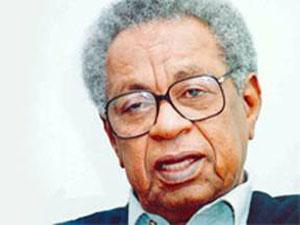
Tayeb Salih
1929 — 2009 · Karmakol-born Sudanese novelist; author of the 1966 novel Mawsim al-Hijra ila ash-Shamal (Season of Migration to the North) — recognised by the Arab Literary Academy of Damascus as the most important Arabic novel of the twentieth century
Al-Tayeb Salih was born on the twelfth of July 1929 in the village of Karmakol, near Al Dabbah on the Nile in Sudan's Northern State. He was raised in a farming community whose rhythms of river, faith, and kinship would later saturate his fiction. He studied at the University of Khartoum, earning a degree in the sciences, before travelling to the University of London — a journey between worlds that became the great subject of his art.
His enduring masterwork, Mawsim al-Hijra ila ash-Shamal (Season of Migration to the North), appeared in 1966. Its principal setting is not Karmakol itself but Wad Hamid, an imagined village on the Nile that Salih conjured and revisited across several works, in the manner of Faulkner's Yoknapatawpha. The novel confronts the wounds of colonialism, exile, and return, and the Damascus-based Arab Literary Academy would later name it among the most important Arabic novels of the twentieth century.
Salih wrote sparingly but with rare depth — The Wedding of Zein, Bandarshah, and a body of stories rooted in the same riverine world. For more than a decade he contributed a weekly column to the London Arabic journal al-Majalla, and he served in broadcasting at the BBC and in cultural work with UNESCO, carrying Sudanese letters onto the world's stage.
He died in London on the eighteenth of February 2009, at seventy-nine, mourned across the Arab world and beyond as "the genius of the Arabic novel." His Nile still runs through every page he left us; his honored name endures wherever a reader returns home.
References
- Tayeb Salih - Wikipedia
- Tayeb Salih | African Studies Centre Leiden
- Season of Migration to the North - Wikipedia
Verified against the public historical record; sources above.
Curated with honor.
⚙ Permanence proof
This entry is pinned to the InterPlanetary File System (IPFS) by our own node so that a copy survives independent of any single web host. Anyone with the content identifier below can fetch a verifiable snapshot from any public IPFS gateway — now and decades from now.
To verify independently, paste the CID into any public IPFS gateway (dweb.link, ipfs.io, cf-ipfs.com).
Carry this life forward
A story shared is a life remembered twice.
From this house to yours
Every family deserves a record like this.
What the house has done here — the story told with dignity, the sources kept, the proof that endures — it does for any name you love. Free to begin, reviewed by human hands, honored the same.
Add to the record
If you knew this person, or know of them —
our editorial team welcomes additions. A fact we missed, an anecdote that belongs in the record, a correction. Each contribution is reviewed by hand and folded into the memorial with attribution. The IPFS record is re-pinned with the additions; nothing is overwritten silently.
Placed in the archive by the Honored Ancestors editorial team.
