
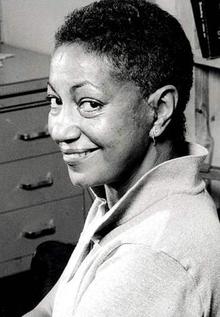
June Jordan
1936 — 2002 · Poet, essayist and architect; founder of Poetry for the People at Berkeley; author of more than thirty books across forty years of public letters
June Millicent Jordan was born on the ninth of July 1936 in Harlem, New York, the only child of Granville Ivanhoe Jordan, a Jamaican-born postal clerk who taught his daughter Shakespeare and the King James Bible, and Mildred Maude Fisher, a Panamanian-born part-time nurse. When she was five the family moved to the Bedford-Stuyvesant district of Brooklyn. She began writing poetry at the age of seven, and after schooling that carried her through a Massachusetts preparatory school and Barnard College, she committed her life to the word as instrument of both beauty and justice.
Jordan's gifts refused a single vessel. In 1964 she joined the architect R. Buckminster Fuller on a visionary redesign of Harlem she titled "Skyrise for Harlem," an act of civic imagination that later won her a Rome Prize in environmental design in 1970. Poet, essayist, novelist, playwright, journalist, and teacher, she published some thirty books across four decades, among them the landmark collection "Things That I Do in the Dark" (1977), edited by Toni Morrison.
Her teaching moved from City College and Yale to Sarah Lawrence, Connecticut College, and SUNY Stony Brook, and finally to the University of California, Berkeley, where from 1989 she was a full professor of English, Women's Studies, and African American Studies. There, in 1991, she founded Poetry for the People, a program that placed the making of poems in the hands of students and communities long told the art was not theirs.
Across her work she wielded Black English as a language of dignity and insisted that poetry belonged to everyone. June Jordan died of breast cancer at her home in Berkeley on the fourteenth of June 2002, aged sixty-five. She remains an honored voice who taught a people to name themselves and to build a more just world in words.
References
- June Jordan - Wikipedia
- June Jordan | Biography | Research Starters | EBSCO Research
- How a Harlem Skyrise Got Hijacked and Forgotten | The Nation
- June Jordan | The Poetry Foundation
Verified against the public historical record; sources above.
Curated with honor.
⚙ Permanence proof
This entry is pinned to the InterPlanetary File System (IPFS) by our own node so that a copy survives independent of any single web host. Anyone with the content identifier below can fetch a verifiable snapshot from any public IPFS gateway — now and decades from now.
To verify independently, paste the CID into any public IPFS gateway (dweb.link, ipfs.io, cf-ipfs.com).
Carry this life forward
A story shared is a life remembered twice.
From this house to yours
Every family deserves a record like this.
What the house has done here — the story told with dignity, the sources kept, the proof that endures — it does for any name you love. Free to begin, reviewed by human hands, honored the same.
Add to the record
If you knew this person, or know of them —
our editorial team welcomes additions. A fact we missed, an anecdote that belongs in the record, a correction. Each contribution is reviewed by hand and folded into the memorial with attribution. The IPFS record is re-pinned with the additions; nothing is overwritten silently.
Placed in the archive by the Honored Ancestors editorial team.
